Interest Rate Cut Implemented, Market Calm: Will the Crypto Market Consolidate or Break Out Next?
Techub News 

微信扫一扫
分享到朋友或朋友圈
分享到朋友或朋友圈
Author: Techub Exclusive Analysis
Written by: Yangz, Techub News
At 2:00 AM on October 30, the Federal Reserve announced a 25 basis point interest rate cut, lowering the target range for the federal funds rate to 3.75%-4.00%, in line with market expectations. This is not only the second rate cut of the year but, combined with the decision to end quantitative tightening (QT) in December, forms a clear signal of a shift toward accommodative monetary policy.
As usual, this news, which is considered positive by traditional financial theory, once again triggered a "sell the news" scenario in the cryptocurrency market. After the announcement, Bitcoin's price fell from $111,800 to a low of $109,200, with a drop of over 2% in one hour. As of the time of writing, Bitcoin has slightly recovered to around $110,900.
This classic "buy the rumor, sell the fact" market behavior has long become a fixed script in the crypto market around major macroeconomic events. Since the "10.11" market flash crash, Bitcoin's price has been fluctuating within the range of $103,000 to $116,000. Now that the rate cut expectations have materialized and the market has calmed, will the future see consolidation or a breakout?
Expectations Fulfilled and "Hawkish Rate Cut"
Regarding this rate cut, the most direct market interpretation is "good news is bad news." Before this FOMC meeting, the probability of a 25 basis point rate cut had been fully priced in by the market. As analyst Ali Martinez pointed out: "Out of the six FOMC meetings this year, five have been accompanied by a Bitcoin pullback." This forms a discernible pattern—traders tend to position themselves ahead of uncertainty and take profits after the announcement to avoid volatility risks once "the other shoe drops."
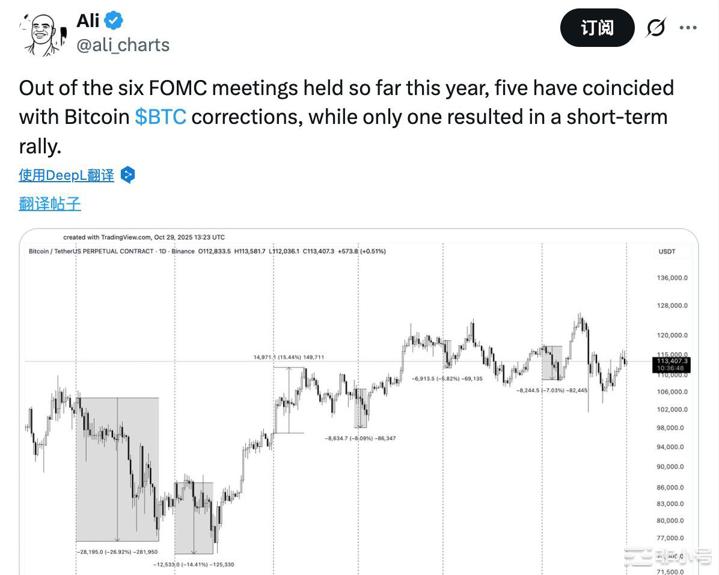
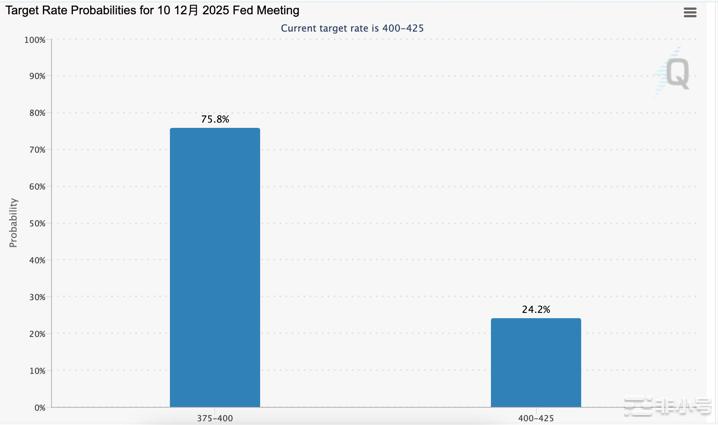
A more critical factor is that this Fed rate cut has been interpreted by the market as having a "hawkish tone." Chairman Powell's statements during the press conference were crucial; he clearly emphasized that "a December rate cut is far from a done deal" and revealed "serious divisions" within the committee regarding the next steps. These remarks undoubtedly poured cold water on the market's enthusiasm for expecting a prolonged rate-cutting cycle. After the meeting, market expectations for a December rate cut also declined. According to CME "FedWatch," the probability of the Fed maintaining rates unchanged in December is as high as 75.8%.
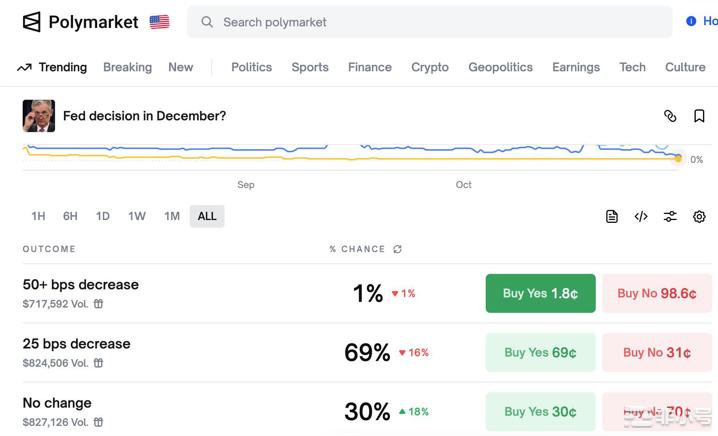
Additionally, as of the time of writing, prediction data on Polymarket regarding the Fed's December interest rate decision shows that the probability of another 25 basis point cut is 69% (down 16%), the probability of no change is 30% (up 18%), and the probability of a 50 basis point or more cut is 1% (down 1%).
Macro Headwinds: The Worrying "Hidden Forces"
Although rate cuts are seen as an important catalyst for pushing the crypto market upward, they are not a panacea. Investors should pay more attention to the economic backdrop behind the rate cuts and the world "after the rate cuts." Currently, several major macro headwinds are keeping investors cautious rather than blindly optimistic.
- Weak Labor Market and Inflation Challenges: The Fed statement noted that "job gains have slowed and the unemployment rate has risen slightly," while acknowledging that "inflation has increased compared to the beginning of the year and remains relatively high." This combination of "slowing growth + stubborn inflation" has raised concerns about the risk of stagflation. In such an environment, although rate cuts reduce the opportunity cost of holding non-yielding assets (like gold and Bitcoin), economic slowdown itself weakens the profit prospects of risk assets, putting investors in a dilemma.
- Data Blackout and Policy Uncertainty: The U.S. government shutdown has led to a lack of key economic data (such as weekly unemployment reports), forcing the Fed to change the wording in its statement from "current indicators" to "available indicators." Powell also admitted that the lack of data could be a reason to pause rate adjustments. This "data fog" makes future policy paths extremely opaque, increasing market uncertainty and volatility.
- Geopolitical and Industry Bubble Long-Term Concerns: Investors' focus has moved beyond the rate cuts themselves to the longer-term future. The spread of corporate layoffs in the U.S., the long-term impact of Trump's tariff wars, and whether there is a speculative bubble in the artificial intelligence sector collectively form a wall of macro headwinds, suppressing overall market risk appetite. Notably, at the time of writing, the presidents of China and the U.S. conveyed signals of friendly cooperation during their meeting in Busan, South Korea.
Long-Term Foundation: Why the Bull Market Logic Remains Solid?
Despite short-term volatility and various macro headwinds, the long-term logic supporting the market has not been shaken, and a more solid foundation is quietly being laid by institutions, policies, and capital.
Capital Influx: Crypto ETFs Have Become an Irreversible Trend
Crypto ETFs have developed into a continuous influx of capital. According to ichaingo data, as of Eastern Time October 29, U.S. Bitcoin spot ETFs have accumulated a net inflow of $4.1 billion this month, with total net assets reaching $149.98 billion, accounting for 6.75% of Bitcoin's total market capitalization; although the net inflow for Ethereum spot ETFs this month is lower than in July and August, it has nearly tripled compared to September's $286 million, with total net assets reaching $26.6 billion, accounting for 5.58% of Ethereum's total market capitalization.
Additionally, on October 28, the first U.S. altcoin ETFs officially launched, covering Solana, Litecoin, and Hedera. According to The Block, these SOL, LTC, and HBAR ETFs had a cumulative trading volume of $65 million on the first day, with Bitwise Solana Staking (BSOL) trading volume reaching $56 million, and opening hour trading volume hitting $10 million, setting a record for the highest first-day trading volume for ETFs this year. The entry of giants like Bitwise and Grayscale marks an expansion in regulatory and market recognition of crypto asset categories. This is not only a victory for projects like SOL and LTC but also opens up broader imagination for the entire industry—an era of multi-asset, multi-strategy crypto ETFs is arriving.
DAT Model Slows but Remains a Force to Be Reckoned With
Tightening regulations are injecting rationality into the heated "Digital Asset Treasury (DAT)" model. Recently, major stock exchanges in the Asia-Pacific region have shown increasingly cautious stances toward listed companies transitioning to DAT companies, drawing clear compliance boundaries for this trend.
The Hong Kong Stock Exchange has questioned at least five listed companies planning to transition to DAT, doubting whether their strategies violate the "Listing Rules" provision prohibiting "holding substantial non-operating liquid assets." Meanwhile, the Bombay Stock Exchange in India rejected Jetking Infotrain's preferential allotment application because it intended to invest part of the raised funds in crypto assets; the Australian Securities Exchange explicitly states that listed companies cannot allocate more than 50% of assets to cash or cash-like assets, institutionally limiting the asset structure of the DAT model.
Despite the stricter regulatory environment, the asset allocation paradigm represented by DAT continues to advance. For example, DAT representative Strategy purchased 390 Bitcoin at an average price of $111,000 between October 20 and 26, bringing total holdings to 640,808 Bitcoin; additionally, Trump family-backed American Bitcoin recently announced an increase of 1,414 Bitcoin, with total reserves reaching 3,865 Bitcoin; Nasdaq-listed Solana Company (HSDT) announced that it acquired approximately 1 million SOL over the past two weeks, with current holdings exceeding 2.3 million SOL.
From a market evolution perspective, current regulatory intervention does not negate the value of crypto assets but is guiding DAT from "concept hype" to "compliant operation." In the short term, regulatory clarity inhibits the rapid replication of the DAT model; in the long term, it paves the way for mature companies with real cash flows, clear business models, and robust treasury management strategies.
DAT, as a structural force, has not disappeared but is entering a new, more rational, and sustainable development phase driven by both regulation and the market. In the future, a batch of high-quality, strongly compliant DAT companies will emerge, further enhancing the pricing weight and allocation status of crypto assets in mainstream capital markets.
Continued Entry of Traditional Financial Giants
The real paradigm shift is happening behind the scenes on Wall Street. Recent developments indicate that traditional financial giants are no longer just testing the waters but are systematically advancing the integration of crypto assets into their businesses: Mastercard plans to acquire crypto infrastructure company Zerohash for $1.5 to $2 billion to strengthen digital asset settlement capabilities within its payment network; Morgan Stanley is supporting its financial advisors and clients in flexibly incorporating cryptocurrencies into their multi-asset investment portfolios; JPMorgan plans to allow institutional clients to use Bitcoin and Ethereum as loan collateral, promoting the evolution of crypto assets into qualified collateral.
These moves indicate that cryptocurrencies are upgrading from "peripheral speculative assets" to "qualified collateral" and "standard allocation options," with traditional financial pipelines fully opening up for crypto assets.
Policy Tailwinds: Regulatory Ice Continues to Melt
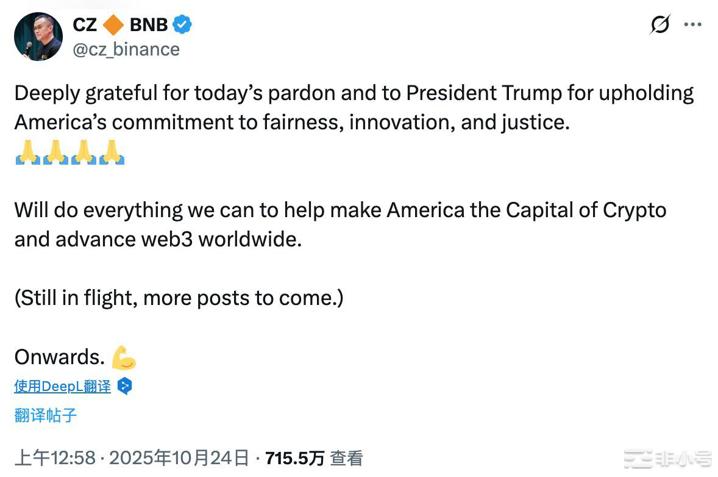
Trump's pardon of Binance founder Changpeng Zhao (CZ) is a highly symbolic signal at the policy level. Coupled with the White House's clear statement that "the cryptocurrency war is over," it has created unprecedented policy certainty for industry development. Meanwhile, White House crypto affairs lead David Sacks revealed that "this year, we are fully capable of passing crypto market structure legislation with bipartisan support, which will ultimately bring the much-needed regulatory clarity to the cryptocurrency industry and solidify the success of the GENIUS Act signed by President Trump earlier this year."
Industry Evolution: From "Adolescence" to "Adulthood"
In terms of industry evolution, multiple dimensions show that the market is maturing. a16z's "2025 State of Crypto Report" points out that with the total cryptocurrency market capitalization surpassing $4 trillion for the first time and stablecoins becoming mainstream, the cryptocurrency industry is bidding farewell to "adolescence" and entering "adulthood." Additionally, as Arthur Hayes proposed in his article "Long Live the King," the dominant factor driving Bitcoin has shifted from the "four-year halving cycle" to the "global liquidity cycle." With China and the U.S. continuously implementing credit expansion as the norm, Bitcoin's bull market foundation is shifting from a scarcity narrative to a broader liquidity narrative, meaning a new analytical framework of "the four-year cycle is dead, long live the liquidity cycle" is forming.
Conclusion: Seizing Long-Term Trends Amid Short-Term Volatility
The Fed's "hawkish rate cut" acts like a prism, reflecting the complex current market landscape: there is both anticipation for improved liquidity and concerns about economic prospects; it faces the pain of short-term technical selling pressure while witnessing the increasing solidification of long-term value foundations.
Bitcoin's ongoing volatility is both a natural reaction to macroeconomic uncertainty and necessary accumulation before a new trend forms. Although the "sell the news" script has played out again, a deeper look at the market's underlying structure reveals that the foundations supporting Bitcoin's long-term value are continuously being strengthened: continuous inflows into crypto ETFs build a stable demand base, systematic layouts by traditional financial institutions open mainstream capital channels, clearer regulatory policies remove obstacles for industry development, and the industry's evolution from "adolescence" to "adulthood" signals the entire ecosystem's move toward maturity. More importantly, market cognition is undergoing a fundamental shift—from relying on the "halving narrative" to embracing the "liquidity cycle," a paradigm shift that provides a broader perspective for understanding Bitcoin's value.
When market noise subsides, the core elements driving value will ultimately stand out—the direction of global liquidity tides, the continuous evolution of technology adoption, and Bitcoin's ultimate positioning as a store of value in the digital age will continue to guide the market's long-term course. In this era of volatility and opportunity, short-term fluctuations will eventually become footnotes in market evolution, while steadfast long-term trends are steadily unfolding in the consensus of every holder.